If you’re researching the Vietnam visa for Philippine citizens in 2026, the first thing I need to tell you might actually save you time and money: you may not need a visa at all. Philippine passport holders currently enjoy 45-day visa-free entry into Vietnam — one of the most generous exemptions Vietnam grants to any ASEAN neighbor. No application form. No fee. No waiting. You land at Tan Son Nhat or Noi Bai, present your Philippine passport at immigration, and you’re in.
But. That 45-day window is not unlimited, and it comes with conditions that catch travelers off guard. Staying longer than 45 days? You need the E-visa. Planning a complex multi-country trip where you’ll exit and re-enter Vietnam? You need the E-visa. Traveling for business purposes where immigration officers might question the nature of a “tourist” visit? Better to have the E-visa in hand. This guide covers both scenarios with complete clarity — the visa exemption and exactly when the 90-day Vietnam E-visa becomes the smarter, safer choice for Philippine travelers in 2026.
One thing I’ll say clearly before we go further: the old VOA approval letter system — the one where you paid an agency for a letter to collect your visa at the airport — is completely dead. Gone. Not coming back. Any website still selling that product to Philippine travelers is either dangerously outdated or actively dishonest. The only valid options in 2026 are the visa exemption and the official 90-day E-visa. Nothing else.
Vietnam Visa Exemption for Philippine Citizens: The 45-Day Rule
Philippine passport holders can enter Vietnam visa-free for stays of up to 45 days. This applies for tourism, family visits, and short business trips. No application required — just a valid passport and onward travel documentation.
What you must have to use the exemption:
- A Philippine passport valid for at least 6 months beyond your intended entry date. Immigration at every Vietnamese airport and land border applies this rule strictly. A passport expiring in three months does not qualify.
- Proof of onward travel — a return ticket or documentation showing you will leave Vietnam before the 45 days expire. Vietnamese immigration does ask for this, particularly at Tan Son Nhat (SGN). Have it accessible.
- Entry within the exemption’s terms. The 45-day visa-free period starts on the date of arrival. If you leave Vietnam and return, the clock resets — but only if sufficient time has passed. Immigration officers have discretion to question frequent short-stay re-entries that look like visa-run patterns.
If your trip is 45 days or under and straightforward, the exemption is the obvious choice. Use it.
When Philippine Citizens Need the Vietnam E-Visa Instead
The 45-day exemption is generous, but several scenarios make the 90-day E-visa the better option:
Staying longer than 45 days. The E-visa grants 90 days per entry — double the exemption window. For OFWs returning to visit family for an extended period, retirees, remote workers doing a proper Southeast Asia stint, or anyone planning a genuinely deep Vietnam experience, the E-visa is the practical choice.
Multiple re-entries on a single trip. The multiple-entry E-visa lets you leave Vietnam — into Cambodia, Laos, or Thailand — and return as many times as you like within the 90-day validity. The visa-free exemption doesn’t carry the same re-entry flexibility when immigration officers are watching patterns.
Business travel where documentation matters. Arriving for meetings, trade visits, or professional engagements on a “visa-free tourist entry” can occasionally draw questions at immigration. The E-visa, with its business-purpose designation, removes that ambiguity entirely.
Peace of mind. Frankly, some travelers simply prefer to have a document in hand. There is nothing wrong with that instinct. The E-visa costs a small fee, takes 3 business days to process, and removes every possible variable from your border crossing.
Vietnam E-Visa Requirements for Philippine Citizens
The Vietnam visa for Philippine citizens — when the E-visa route is chosen — grants 90 days of stay, single or multiple entry. Here is what you need before opening the application:
- A Philippine passport valid for at least 6 months beyond your intended Vietnam entry date.
- A recent passport-style photo: white background, full face, no glasses, taken within the last 6 months. A clean photo, not a phone selfie cropped from a birthday party.
- A clear, high-resolution scan of your passport bio-data page — the page with your photo, full name, date of birth, passport number, and expiry date.
- A valid email address to receive your approval PDF.
- A credit or debit card for the application fee.
Standard processing: 3 business days. Apply at least 7 to 10 days before departure. The few minutes you save by applying last-minute are not worth the hours of stress if something needs correcting.
Denied Boarding at MNL or CEB: What Happens When Your Visa Isn’t Ready
The Philippines has two major international departure hubs: Ninoy Aquino International Airport (MNL) in Manila and Mactan-Cebu International Airport (CEB) in Cebu. Both handle direct Vietnam flights — Manila to Hanoi, Manila to Ho Chi Minh City, Cebu to Da Nang. These are busy routes. Filipinos travel to Vietnam constantly for tourism, OFW family reunions, business, and honeymoons. The check-in lines move fast and the agents are thorough.
If you’re traveling on the E-visa and the document has an error — a name mismatch, a processing delay you didn’t notice, an approval email sitting unread in spam — you find out at the check-in desk. Not at the gate. At the desk, when you still have time to act. That’s actually the marginally less terrible version of this scenario. The worse version is finding out at Vietnamese immigration after a flight you somehow boarded.
Either way: if you’re at MNL or CEB and your E-visa situation has gone wrong, call our emergency team immediately. The Super Urgent Visa Service processes a new E-visa application through priority government channels and delivers a fully valid, government-approved approval document within 2 to 4 hours. Not a workaround. An official E-visa. Time is the only resource that matters at that point, so don’t waste it trying to navigate the standard portal alone.
💡 Expert Insight from Stanley Ho: “Over my 20+ years handling travel logistics, the most frequent disruption occurs at the check-in desk due to simple application formatting errors. If you are stuck at the airport and denied boarding, don’t panic—our emergency team can secure a new E-visa clearance through priority channels within hours, saving your flight.”
The Philippine Passport Trap: Name Formatting Errors That Kill Applications
This is where I need every Filipino applicant to slow down and pay attention. Philippine passport naming conventions are genuinely one of the most mismatched with the Vietnam E-visa portal’s two-field system — and the mismatch causes more application problems from the Philippines than almost any other nationality I deal with.
The three-name structure. Philippine passports record names in three parts: Given Name, Middle Name (which is the mother’s maiden surname), and Surname (the father’s family name). The E-visa portal has two fields: “Given Name” and “Surname/Family Name.” So where does the middle name go?
The answer is: in the machine-readable strip at the bottom of your passport bio-data page. That strip is what Vietnamese immigration systems check. On most Philippine passports, the machine-readable strip records the full name as: SURNAME<<GIVEN NAME<MIDDLE NAME INITIAL or SURNAME<<GIVEN NAME MIDDLE NAME (depending on passport generation). Enter your name in the E-visa form to match the machine-readable strip exactly — not how you write your name in everyday life, not how your full name appears in the visual zone, but what those two lines of capital letters at the bottom of your bio-data page actually say.
The “dela Cruz” / “de los Santos” particle trap. Spanish-origin particles in Filipino surnames — “dela,” “de la,” “de los,” “delos,” “del,” “de,” “san,” “santo” — are handled inconsistently across Philippine passport generations. Older passports might record “DE LA CRUZ” as three separate tokens in the machine-readable strip. Newer passports often merge it as “DELA CRUZ” or “DELACRUZ.” Check yours. Enter exactly what the strip shows. If the strip reads DELACRUZ, don’t enter De La Cruz on the form — the mismatch will flag your application.
Middle names versus middle initials. Some Philippine passports display the full middle name in the machine-readable strip (SANTOS); others show only the initial (S). Enter what the strip shows. Adding your full middle name when the strip only carries the initial creates a discrepancy that delays processing.
ePassport versus older maroon passport formatting. Philippine ePassports (issued from around 2009 onward) have a more standardized machine-readable strip. If you’re still traveling on an older-generation passport, the strip formatting may differ from what you expect. In all cases: the strip governs. Read it character by character before you type anything into the E-visa form.
Submit through our professional service if you have any doubt about name formatting — we review every application for machine-readable strip alignment before submission.
Skip the Queue: VIP Fast-Track at Vietnam’s Airports
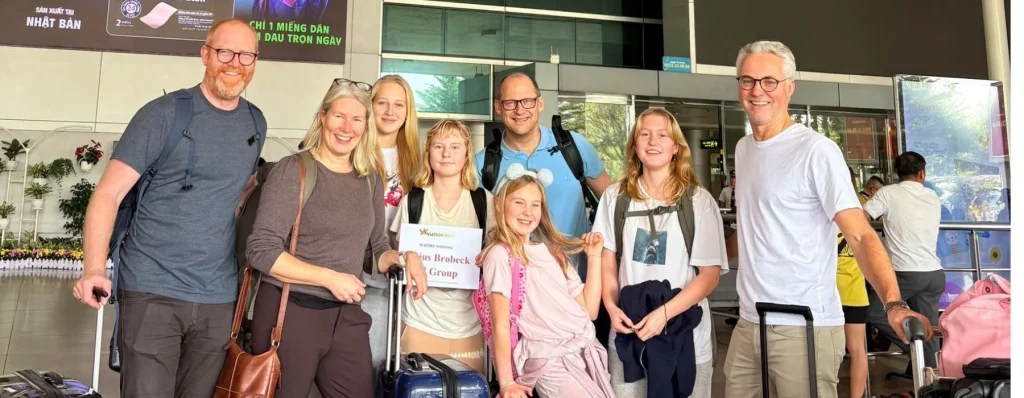
Manila to Ho Chi Minh City is a direct 2.5-hour flight. Practically a commute by regional standards. Filipino travelers do this route constantly — for weekends, for business, for OFW family visits staged through Vietnam on the way home. Even on a short flight, the arrival immigration queue at Tan Son Nhat during peak hours can run 45 minutes to an hour when multiple wide-body aircraft land simultaneously.
The VIP Airport Fast-Track service bypasses all of that. A personal concierge meets you at the aircraft gate before the terminal crush begins and escorts you through a dedicated priority immigration lane. Your passport is processed while the general queue is still sorting itself out. You’re through, bags collected, and heading to your hotel in the time it would have taken to reach the front of the standard line.
The service operates at Vietnam’s three main international airports: Noi Bai International in Hanoi (HAN), Tan Son Nhat International in Ho Chi Minh City (SGN), and Da Nang International Airport (DAD). Add it when you apply for your E-visa. For business travelers on tight Manila-to-HCMC day-trip schedules, it’s indispensable. For leisure travelers who simply don’t want their first impression of Vietnam to be a fluorescent-lit queue — it’s one of the best small investments you’ll make on the trip.
How to Apply for Your Vietnam E-Visa in 2026
Step by step, no ambiguity:
- Go to a verified application service such as visaonlinevietnam.com. Our service includes document quality review and name-matching checks — particularly important for Philippine applicants given the naming convention issues described above.
- Open your physical passport to the bio-data page. Read the machine-readable strip at the bottom. That is your reference for every name field. Do not type from memory. Do not use your name as it appears on your driver’s license or any other document. The passport machine-readable strip is the only source.
- Enter your personal details. Given name and surname as they appear in the machine-readable strip. Date of birth, nationality, passport number, and expiry date — all matching the bio-data page exactly.
- Select your entry type. Single-entry for a clean point-to-point trip. Multiple-entry if you’re combining Vietnam with other Southeast Asian destinations and plan to re-enter.
- Upload your documents. Passport bio-data page scan — sharp, well-lit, fully legible. Passport-style photo — white background, full face, no glasses. Quality matters; blurry or poorly lit submissions are rejected automatically.
- Add VIP Fast-Track if you want it. Book it now, not when you’re exhausted at the arrival hall.
- Pay and submit. Save your payment confirmation and application reference somewhere accessible — screenshot it, write it down, put it in a notes app that doesn’t require wifi to open.
- Receive your approval by email. Standard processing: 3 business days. Urgent: 2 to 4 hours. Your approval document arrives as a PDF.
- Print it or save it digitally. Vietnam accepts both. Keep a backup copy in cloud storage. A printed copy in your hand luggage has never caused anyone a problem at immigration.
Frequently Asked Questions
Do Philippine citizens need a visa to visit Vietnam in 2026?
Not always. Philippine passport holders can enter Vietnam visa-free for stays of up to 45 days — no application, no fee, just a valid passport and proof of onward travel. If you’re staying longer than 45 days, planning multiple entries, or want the flexibility of the 90-day window, the Vietnam visa for Philippine citizens means the official 90-day E-visa applied for online. The old VOA approval letter system is completely discontinued and does not exist in any legitimate form in 2026.
How long does the Vietnam E-visa allow Philippine passport holders to stay?
The E-visa grants 90 days per entry — single or multiple entry, your choice at the time of application. The 90-day period starts on the date of first entry, not the date of application or issue. Multiple-entry means you can leave and re-enter Vietnam as many times as needed within that validity period.
Where do I put my middle name on the Vietnam E-visa application form?
Enter your name exactly as it appears in the machine-readable strip at the bottom of your Philippine passport bio-data page — not as it reads in the visual zone. Most Philippine ePassports record the full name in the strip in a specific format. In the “Given Name” field, enter your given name and middle name as the strip shows them combined. In the “Surname” field, enter your family surname exactly as it appears in the strip, including any Spanish-origin particles (dela, delos, del, de) formatted exactly as the strip shows.
The Vietnam Embassy is in Manila — do I need to go there to apply?
No. The E-visa is entirely online. There is no embassy visit required, no passport submission, no queuing at the Vietnamese Embassy in Roxas Boulevard. You apply from your phone or laptop, receive approval by email, and present the PDF at the Vietnamese border. The embassy exists for other consular services; for tourist and business E-visas in 2026, it is not part of the process.
Can I extend my Vietnam E-visa once I’m already in the country?
Extensions are technically possible through Vietnamese immigration authorities but are not straightforward or guaranteed. My practical advice: if you think you’ll want more than 90 days, apply for the multiple-entry E-visa, plan a short exit to Cambodia or Laos (both very accessible from Vietnam), and re-enter on the same valid visa. That’s a far simpler solution than extension paperwork filed from inside Vietnam.
About the Reviewer: Stanley Ho is the CEO of VisaOnlineVietnam and a recognized expert consultant in the international aviation and travel service industry. With decades of experience navigating complex immigration regulations, Stanley and his team specialize in providing seamless visa solutions, fast-track airport services, and emergency travel assistance for global citizens visiting Vietnam.